Crypto Market Psychology: How Fear and Greed Shape Market Cycles
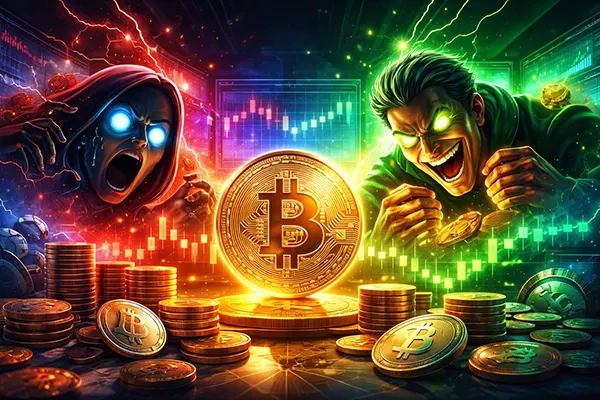
Crypto prices rarely move on logic alone. Even in 2026, with tighter compliance standards, clearer regulatory frameworks in many regions, and higher institutional participation, the market still reacts to emotion faster than it reacts to fundamentals. You can see it in sudden rallies that ignore negative signals, as well as in sharp sell-offs that arrive before any real damage is fully confirmed.
Why emotions move crypto faster than fundamentals
Crypto is especially sensitive to collective mood because it trades 24/7, has relatively high retail involvement, and spreads narratives through social media at high speed. When traders feel confident, they often buy because “everyone is buying”. When they feel threatened, they sell first and look for explanations after. This is why sentiment in crypto often leads price action instead of following it.
Fear and greed also influence how the same information is interpreted. A neutral event — such as a regulatory statement, an exchange rumour, or a macroeconomic comment — can look bullish when optimism dominates and disastrous when pessimism dominates. In practice, this creates feedback loops: rising prices feed greed, falling prices feed fear, and both emotions intensify the trend already in motion.
That is why crypto cycles tend to look exaggerated compared to many traditional assets. Technology, adoption and infrastructure evolve gradually, but crowd confidence can flip within hours. By 2026 the market is more mature than in earlier boom periods, yet fast emotional swings remain one of its defining traits.
The Fear & Greed Index as a snapshot of market mood
One of the most referenced sentiment indicators is the Crypto Fear & Greed Index. It combines different signals — including volatility, market momentum, social activity and dominance metrics — into a single score from 0 to 100. The index is designed to reflect whether market behaviour is driven by panic-like caution or by overheated optimism.
The value of this tool is not that it predicts exact turning points. Its strength is that it describes the current emotional climate. When the reading stays in “extreme greed” for a prolonged period, it often aligns with higher leverage, crowded long positions and unrealistic expectations. When it stays in “extreme fear”, it often reflects forced selling, liquidation pressure and the general refusal to take risk.
The most practical approach is to use it in context. A fear reading during a slow correction is not the same as fear during a cascade of liquidations. Treat it as a label for market mood, and combine it with structure, volume behaviour and broader risk conditions.
How fear drives capitulation and resets the market
Fear is the emotion that makes investors treat volatility as a threat rather than an opportunity. In crypto, fear rarely builds slowly — it often arrives as a wave triggered by a sharp drawdown, sudden insolvency news, large-scale liquidations, or a failure that breaks trust. This is why the market can fall faster than it rises.
Capitulation happens when people sell not because they want to, but because they feel they must. That includes retail panic selling, leveraged traders being forced out by margin calls, and professional investors reducing exposure to stay within risk limits. When capitulation spreads, price can overshoot far below what many would consider “fair value” simply because liquidity disappears at the wrong moment.
Historically, major fear events have influenced the next cycle’s behaviour. After collapses, investors become more selective, leverage becomes harder to justify, and narratives shift from “easy money” to “security and trust”. This emotional reset is one reason market cycles keep repeating, even when the catalysts change.
Fear triggers: stablecoin stress and exchange-related shocks
One of the clearest modern examples of fear-driven collapse was the Terra ecosystem failure in May 2022, which showed how quickly a confidence-based system can unravel once redemption pressure accelerates. The scale and speed of that breakdown reshaped how many traders evaluate stablecoin risk and yield promises.
Events like this matter because they break assumptions. Many people believed certain mechanisms were “tested enough” until the market proved otherwise. Once fear spreads, it rarely stays isolated — it often creates suspicion about other stablecoins, other yield products and custodial risks at the same time.
By 2026, participants have better tools for risk control and more transparency in parts of the industry, but fear triggers still look familiar: liquidity dries up, spreads widen, and even stronger assets get sold to cover losses elsewhere. The core lesson is that fear changes behaviour, and behaviour changes market structure.
How greed fuels bubbles, market tops, and violent reversals
Greed in crypto is not only about wanting profit. It is about believing that upside is unlimited and time is running out. That belief drives late-cycle behaviour: chasing price spikes, using excessive leverage, ignoring risk warnings, and treating short-term momentum as proof of long-term value.
Greed compresses decision-making. When prices rise quickly, fear of missing out becomes stronger than fear of losing money. In this phase, market participants stop asking “what could go wrong?” and instead ask “how high can it go?” This shift can be observed through funding rates, rapid inflows into speculative assets and the sudden popularity of projects with weak fundamentals.
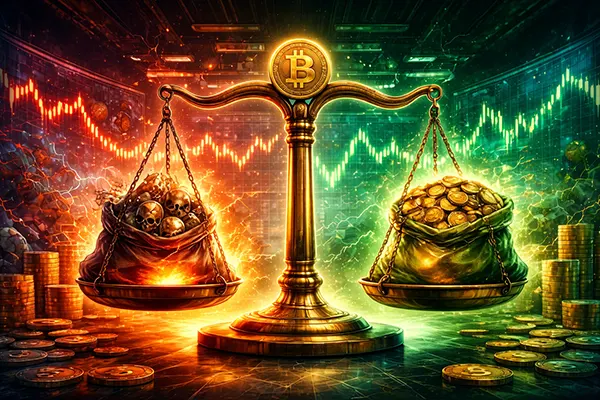
The problem is that greed-based rallies are structurally fragile. They rely on continuous inflows and growing confidence. If inflows slow down, the same leverage that amplified gains becomes the reason for abrupt crashes. In other words, greed builds instability — and the reversal often arrives faster than most people expect.
Greed around supply narratives and timing errors
Bitcoin’s most recent halving occurred in April 2024, reducing the block reward from 6.25 BTC to 3.125 BTC. Around such events, greed tends to rise because traders expect history to repeat itself through a strong post-halving rally. This often creates a self-reinforcing narrative before the market even proves the outcome.
Psychologically, many participants “front-run the story”. They buy because they believe others will buy, and the narrative becomes temporarily self-fulfilling. But when too many expect the same result, the market becomes vulnerable to disappointment. If price does not rise fast enough, mood can flip from greed to frustration and then to fear.
By 2026, many experienced investors understand that halvings are not automatic profit triggers. They are supply events that interact with liquidity, macro conditions and overall risk appetite. The psychological trap is that greed thrives on certainty, while markets often punish certainty when it becomes crowded.